Evolutionary Multiobjective Optimization Driven by Generative Adversarial Networks
Abstract
Traditional evolutionary algorithms generate offspring through genetic operators such as crossover and mutation, which rely on local perturbations of existing solutions. This work presents GMOEA, a novel paradigm where Generative Adversarial Networks (GANs) are employed to learn the distribution of promising solutions and generate high-quality offspring. The GAN's generator learns to model the manifold of the Pareto-optimal set, enabling it to produce diverse, well-distributed candidate solutions in a single forward pass. A discriminator provides selection pressure by distinguishing between high- and low-quality solutions. This distribution-learning approach significantly improves search efficiency, particularly on problems with complex Pareto set geometries where traditional operators struggle. Experiments on benchmark suites and real-world problems demonstrate GMOEA's superior performance over state-of-the-art model-based and decomposition-based MOEAs.
Paper figures
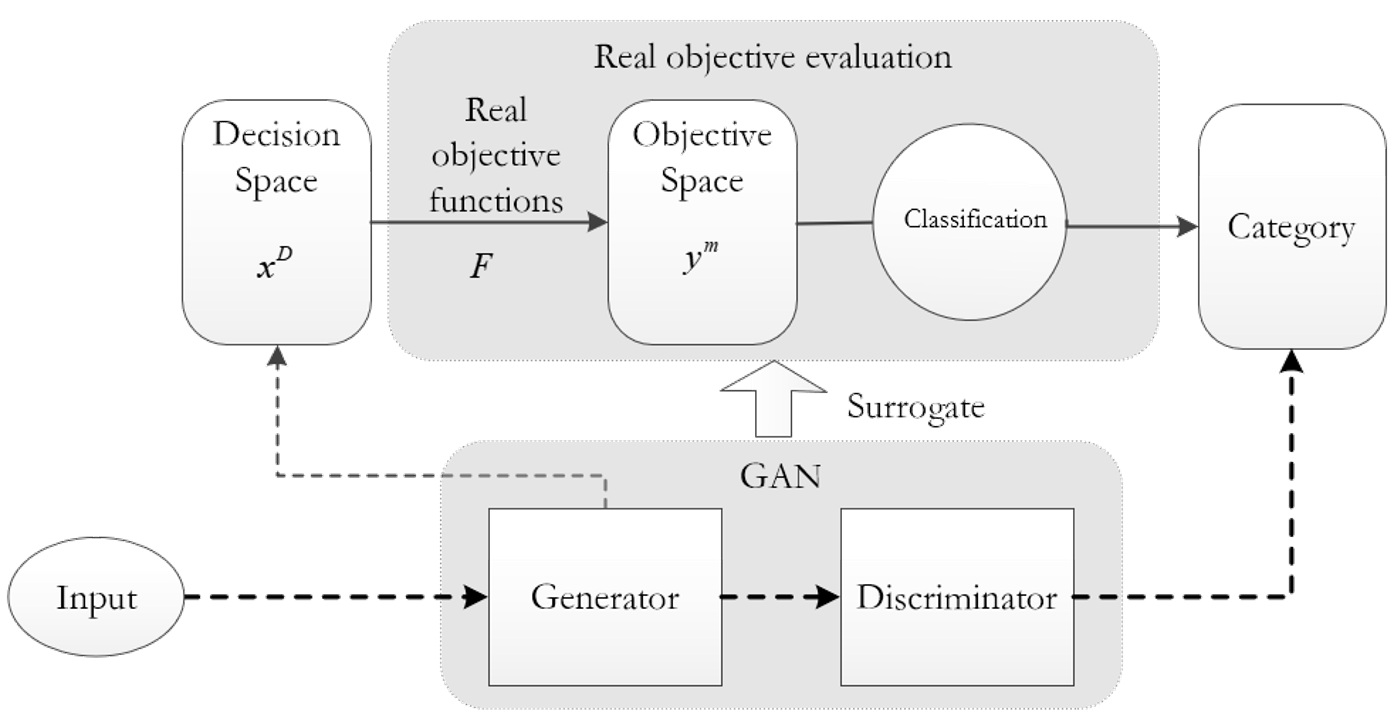
Paper figure: Pareto front approximation on multiobjective benchmark, illustrating the distribution of GAN-generated offspring. The GAN learns the underlying manifold of the Pareto set, enabling efficient sampling of diverse, high-quality candidate solutions.
Key contributions
- First use of GANs for offspring generation in evolutionary multiobjective optimization — replacing traditional crossover/mutation with learned distribution sampling.
- The generator learns the manifold of the Pareto-optimal set, producing diverse candidate solutions in a single forward pass.
- A discriminator-guided selection mechanism distinguishes promising solutions, providing implicit fitness without expensive function evaluations.
Resources