A Classification-Based Surrogate-Assisted Evolutionary Algorithm for Expensive Many-Objective Optimization
Abstract
Surrogate-assisted evolutionary algorithms have been widely developed for expensive optimization problems where each function evaluation incurs substantial computational cost. However, extending surrogates to many-objective optimization (4+ objectives) presents unique challenges: the surrogate must accurately predict not only objective values but also dominance relationships in high-dimensional objective space. This work introduces CSEA, which reframes surrogate modeling as a classification problem. Rather than regressing individual objective values, a classifier is trained to predict whether a candidate solution dominates a reference set of solutions — a binary decision that is substantially easier to learn and more robust. A feedforward neural network serves as the classifier, with training data generated from archived non-dominated solutions. CSEA demonstrated state-of-the-art performance on expensive many-objective benchmarks (up to 10 objectives), establishing classification-based surrogates as an effective paradigm for expensive evolutionary optimization.
Paper figures
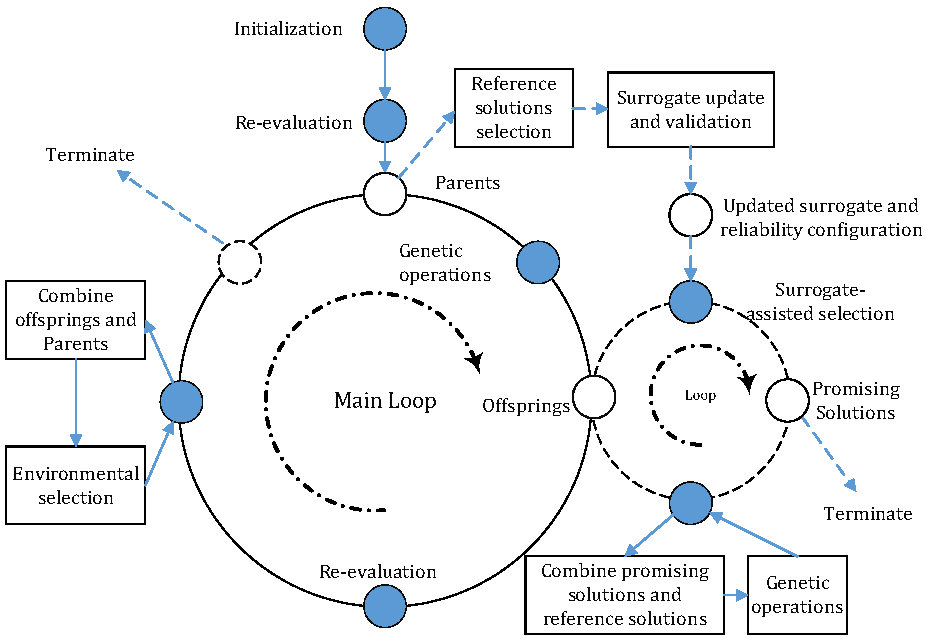
Paper figure: Algorithm framework diagram of CSEA. The figure illustrates how the neural network classifier is trained on archived non-dominated solutions to predict dominance relationships, replacing expensive regression-based surrogates with a more robust classification task. This design enables efficient many-objective optimization with limited function evaluations.
Key contributions
- Classification-based surrogate modeling reframes the surrogate task from regression (predicting objective values) to classification (predicting dominance), which is more robust in high-dimensional objective space.
- A neural network classifier trained on archived non-dominated solutions predicts whether candidate solutions are promising, dramatically reducing expensive function evaluations.
- Validated on benchmarks with up to 10 objectives and real-world engineering problems, establishing CSEA as one of the most-cited surrogate-assisted many-objective EAs.