Evolutionary Large-Scale Multiobjective Optimization for Ratio Error Estimation of Voltage Transformers
Abstract
Voltage transformers (VTs) are critical measurement devices in power systems, and their ratio errors directly impact energy metering accuracy and system protection. This work bridges the gap between electrical measurement and evolutionary computation by formulating VT ratio error estimation as a large-scale constrained multiobjective optimization problem. The resulting benchmark, TREE (Transformer Ratio Error Estimation), captures realistic physical constraints from transmission line models, bus voltage consistency, and Kirchhoff's laws, yielding problems with hundreds of decision variables and constraints. A tailored evolutionary algorithm incorporating problem-specific knowledge is developed for efficient solving. The TREE benchmark serves as a reproducible testbed for large-scale constrained MOEAs while addressing a genuine industrial need in smart grid metrology.
Paper figures
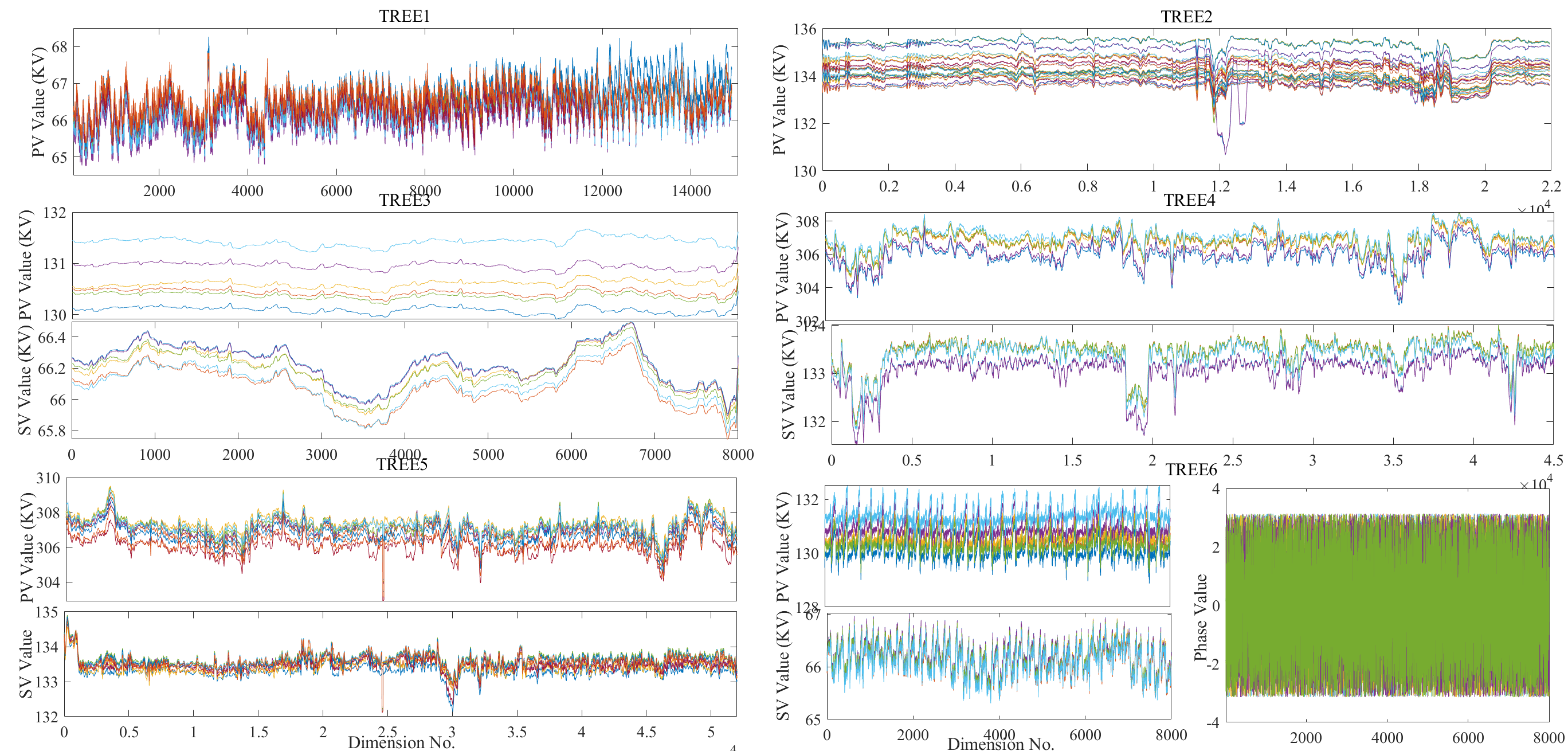
Paper figure: Optimization landscape and Pareto front approximation for the TREE benchmark. The figure shows the trade-off surface between ratio error estimation accuracy and phase displacement error across the power grid, illustrating the non-convex nature of this real-world constrained multiobjective optimization problem.
Key contributions
- First bridge between electrical measurement (VT calibration) and evolutionary large-scale multiobjective optimization, translating a practical industrial problem into a reproducible benchmark.
- The TREE benchmark incorporates realistic physical constraints (transmission line models, bus voltage consistency, Kirchhoff's laws), producing problems with hundreds of variables and mixed-type constraints.
- A problem-specific EA exploits domain knowledge for efficient ratio error estimation, outperforming general-purpose large-scale MOEAs.
Resources