Online Evaluation of Measurement Uncertainty in Sensor Networks: A Case Study on Voltage Transformers
Abstract
Sensor networks serve as the perceptual core of industrial systems such as the Internet of Things and smart grid, where individual measurement accuracy is pivotal to reliable state estimation. However, environmental interference and device aging introduce measurement uncertainties that propagate and accumulate across the network. This work proposes a recursive framework for online evaluation of measurement uncertainties within sensor networks, demonstrated through voltage transformers in the smart grid. The method incorporates a measurement model to capture interdevice dependencies and utilizes the Monte Carlo method to propagate parameter distributions. Calibrated nodes are selected based on uncertainty propagation theory, and Bayesian fusion estimates the parameter distributions of extended nodes. Validation on the IEEE 30-node system and real-world power grid data confirms high evaluation accuracy and stable uncertainty propagation.
Paper figures
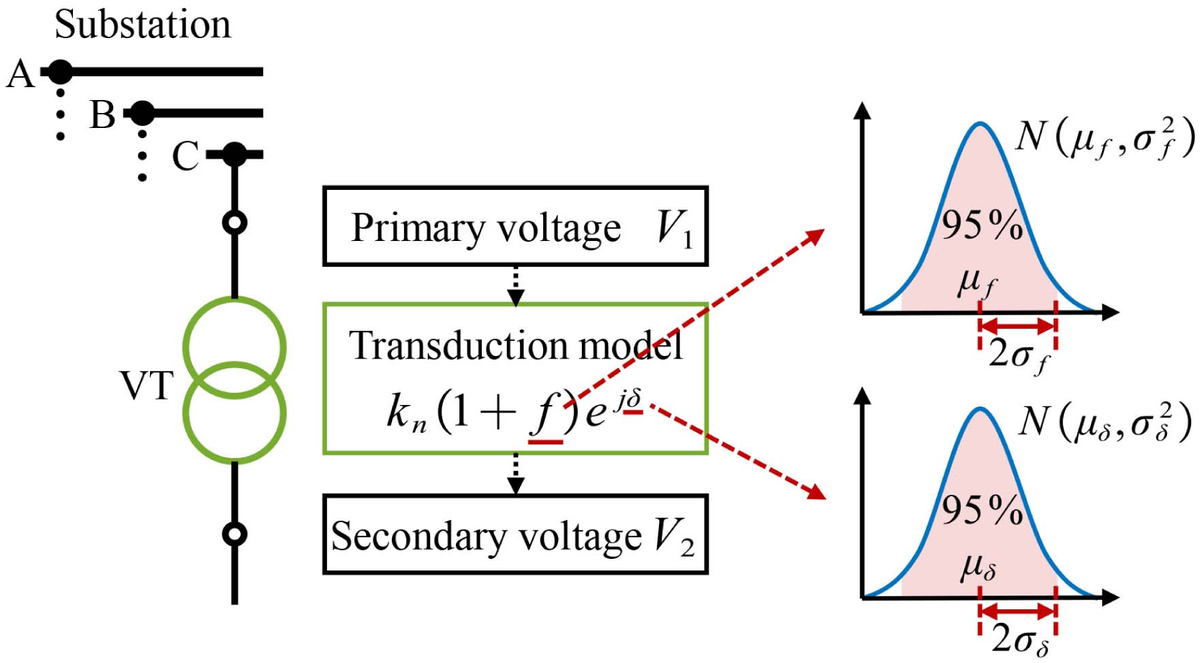
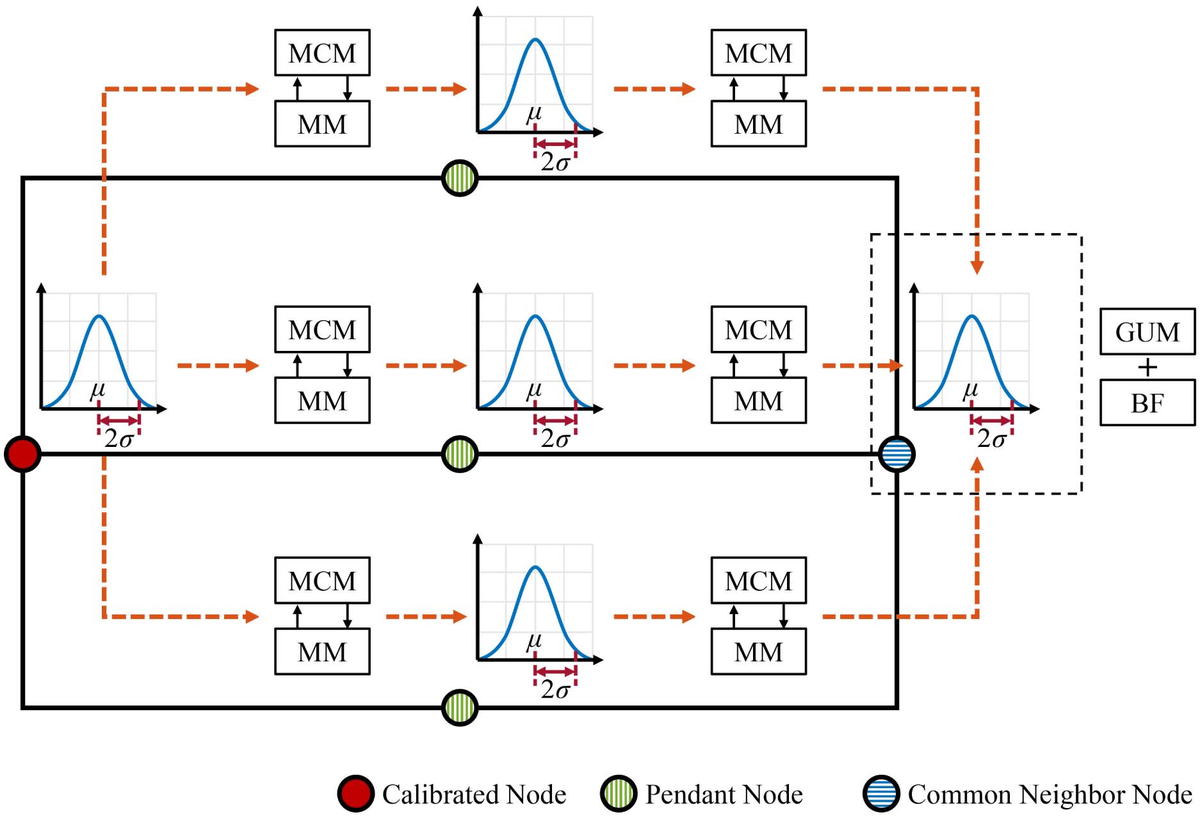
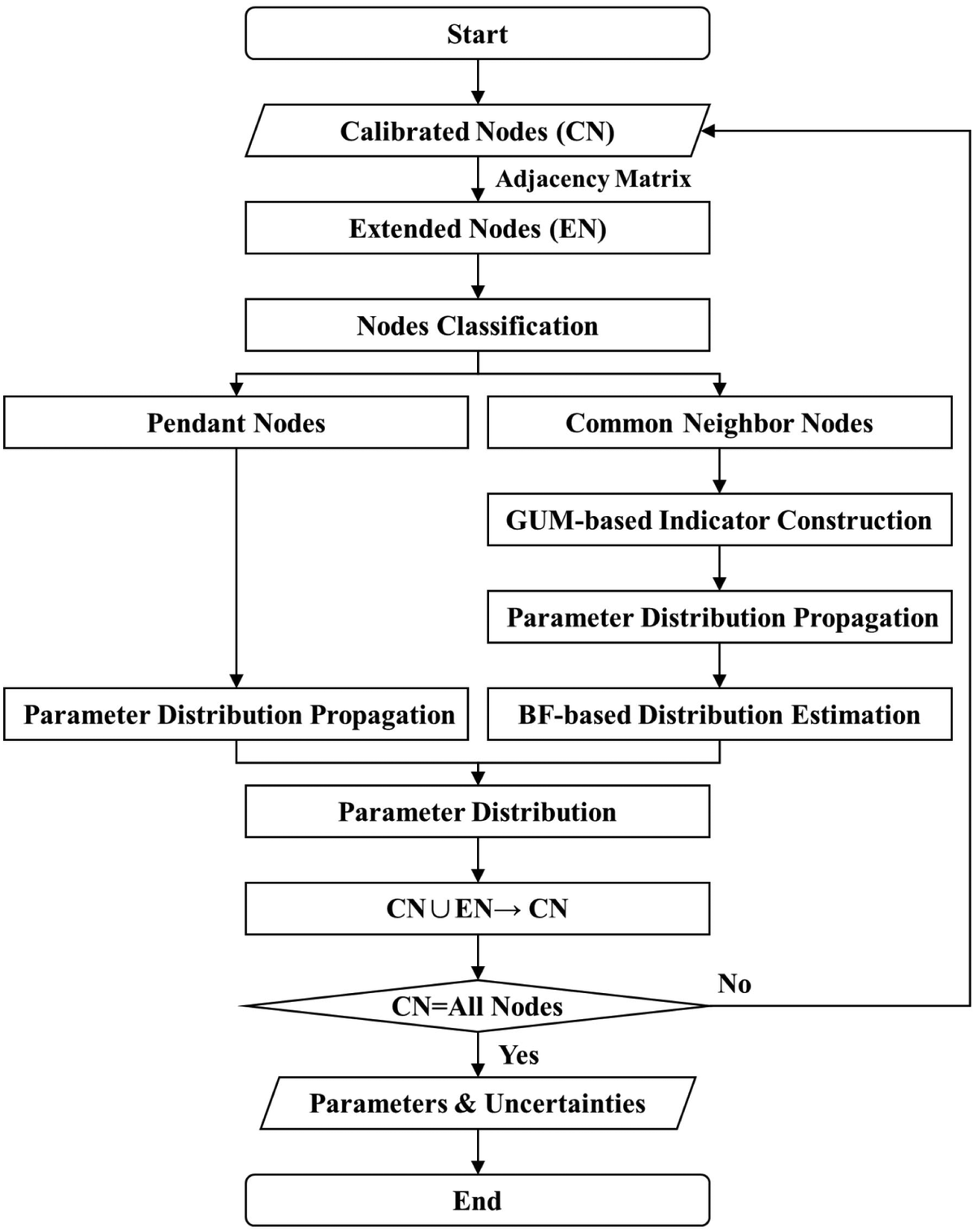
Figures from the paper. Top: Voltage transformer measurement model in the smart grid (Fig. 1). Middle: Network-level measurement model (Fig. 2). Bottom: Recursive evaluation workflow with experimental validation.
Key contributions
- A measurement model (MM) characterizes interdevice dependencies between adjacent sensors by linking transduction model parameters, enabling parameter distribution propagation across the network.
- A recursive evaluation workflow selects calibrated nodes with minimum uncertainty increment via uncertainty propagation theory, then applies Bayesian fusion to estimate parameter distributions of extended nodes.
- Validated on the IEEE 30-node system and real-world power system data, demonstrating high evaluation accuracy with stable uncertainty propagation over extended distances.
Resources